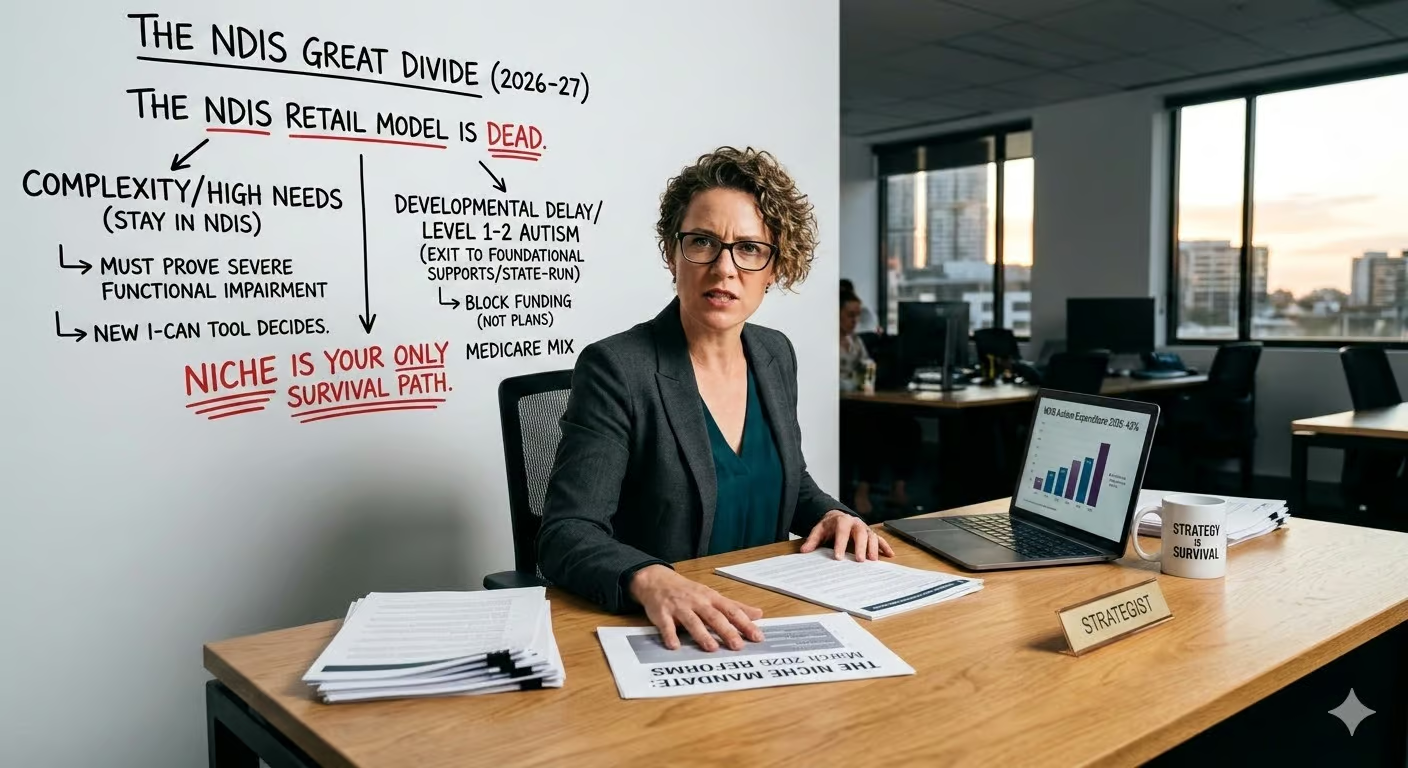
If you are an NDIS provider currently working with children on the autism spectrum, I have a blunt message for you: The “Generalist” era of the NDIS is officially over. The headlines from this past week aren’t just noise; they are the death knell for the business model we’ve known for the last decade. With the closing of the “New Framework” consultations on March 6 and the concrete rollout dates for the Thriving Kids program now set, the floor is moving beneath your feet.
If you don’t niche down—and do it immediately—your business will not survive the 2026 transition. Here is why.
The End of the “Retail Model”
For years, NDIS providers have operated in a “retail” environment. You marketed to families, they had a bucket of money (their plan), and they chose you. It was a classic fee-for-service market.
That is dying. The government is moving toward “Foundational Supports.” For the thousands of kids with Level 1 or 2 autism and “low to moderate” needs, the individual NDIS plan is being replaced by the Thriving Kids program. By October 2026, the money for this cohort is moving away from individual “wallets” and into State Government block-funding.
If your “niche” is simply “kids with autism,” you are about to find yourself competing with massive, state-contracted health hubs for a fraction of the current hourly rate.
The I-CAN Tool: A Filter, Not a Fountain
The introduction of the I-CAN v6 assessment tool in mid-2026 is designed to do one thing: filter.
The NDIA is no longer interested in a diagnosis. They are obsessed with Functional Impairment. If you are a generalist therapist writing reports that focus on “Autism Spectrum Disorder,” you are failing your clients and your business.
To survive in the NDIS ecosystem from 2026 onwards, you must niche into Complexity. The only providers who will keep their NDIS revenue streams are those who specialize in “Substantially Reduced Functional Capacity.” That means non-verbal communication, high-intensity sensory processing, or severe behavioral support.
Why Niche is Your Only Survival Path
I see providers every day trying to “do it all.” They take every referral that comes through the door. In the new world order, that is a recipe for bankruptcy.
-
- Efficiency in Evidence: Under the New Framework, you won’t be paid to write “general” progress reports. You need to be a specialist in the specific metrics the I-CAN tool measures. If you niche, your clinical documentation becomes a precision instrument that protects your clients’ funding.
-
- Referral Dominance: When the “mild to moderate” kids move to the Thriving Kids program, the NDIS will become a “High-Needs Only” club. Support Coordinators will only look for specialists. If you are “just another OT,” you are invisible. If you are “The OT for Pathological Demand Avoidance (PDA) and AAC,” you are indispensable.
-
- The Tender Trap: If you choose to follow the “low-needs” cohort into Foundational Supports, you need scale. You aren’t a boutique clinic anymore; you’re a government contractor. If you don’t have the stomach for high-volume, lower-margin work, you must pivot to the high-complexity NDIS niche now.
The Verdict
The NDIS is shrinking its borders. You are either inside the fence—dealing with the most complex 10% of the population—or you are outside in the new state-based “Foundational” wilderness.
Both are valid business models, but you cannot be in both.
My advice? Stop trying to be everything to every family. Pick your side of the Great Divide. Audit your current caseload. If 80% of your kids are “Level 1” and likely to be transitioned out by 2028, you don’t have a business—you have a countdown clock.
Niche down. Specialize in what the machine can’t automate. Become so essential to complex cases that the NDIA wouldn’t dare cut your client’s budget.
The clock is ticking. October 2026 is closer than you think.
By Aristotelis Dimou, NDIS Marketing Agency Strategist